
Most people's first go with AI ends in disappointment, and it's usually because they asked it to do something it was never able to do. So here's the honest split.
Start with what the thing actually is. AI is a prediction engine, not a brain. It has read an enormous number of examples of human writing and learned the patterns in them, so when you ask it something it predicts the most useful response. That one fact explains everything below. It isn't thinking about your question, and it knows nothing about your business unless you tell it.
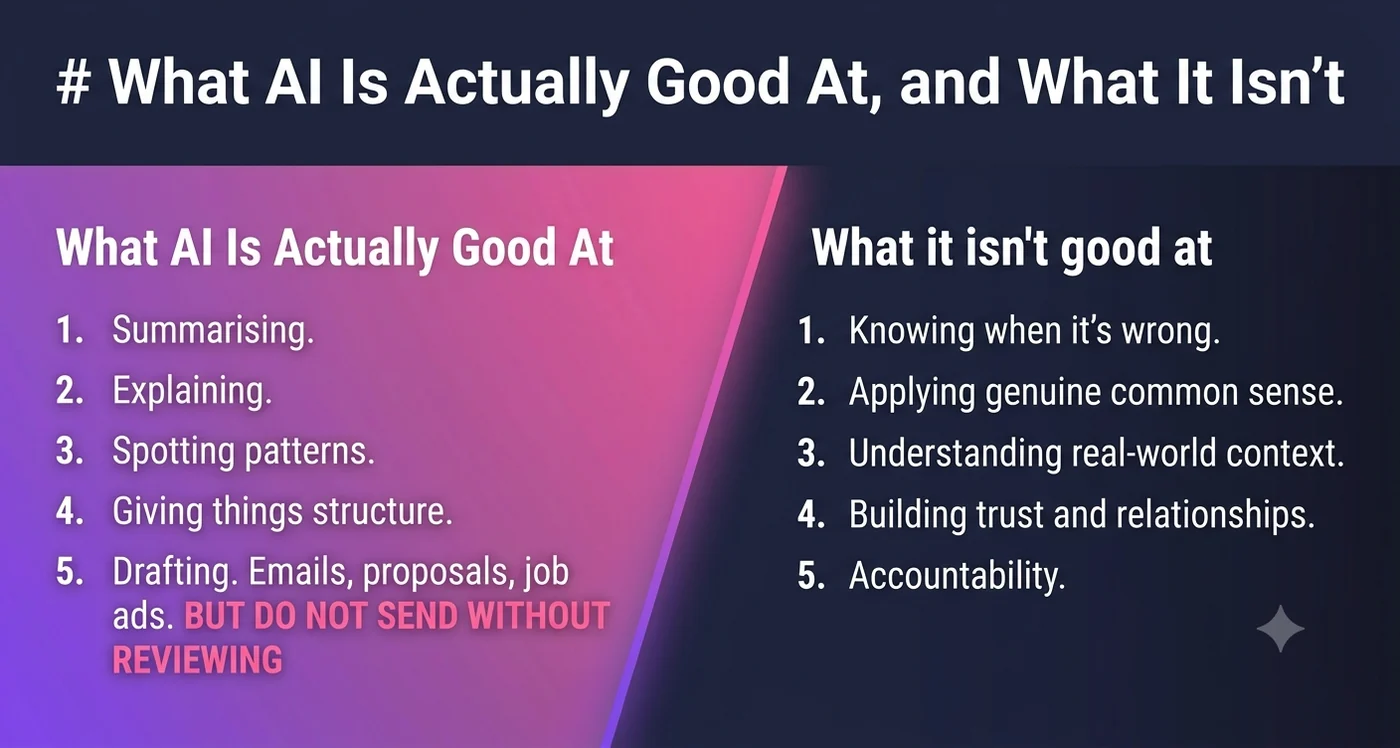
**What it's genuinely good at:
- Summarising. A forty page document, a messy email thread, an hour of meeting notes, down to what you actually need to act on.
- Explaining. Any complex topic in plain language, at whatever level you ask for. This is the one people underuse most.
- Spotting patterns. Give it a spreadsheet and ask what looks unusual, or which customers have gone quiet.
- Giving things structure. Describe how you do a job and it'll turn it into a written process, a template or a checklist.
- Drafting. Emails, letters, proposals, posts, job ads. A first draft in seconds that you then make yours. DO NOT SEND WITHOUT REVIEWING
**What it isn't good at:
- Knowing when it's wrong. This is arguably its biggest weakness. AI can produce an answer that sounds extremely confident while being completely incorrect, which the industry politely calls a hallucination. Unlike a human expert, it doesn't naturally know the limits of its own knowledge.
- Applying genuine common sense. Humans accumulate millions of everyday experiences. AI learns patterns from data, so it still trips over things that are obvious to any person. It will happily suggest putting wet clothes in a cupboard to dry, or propose a physical action nobody could perform.
- Understanding real-world context. It only sees the information you give it. It doesn't know what happened five minutes ago in your office, your colleague's personality, or the politics inside your company.
- Building trust and relationships. People buy from people. AI can't build rapport, earn trust over years, handle the emotions inside a difficult negotiation, or read what's really motivating someone.
- Accountability. It can help you think a decision through. It can't make the decision, and if the decision turns out to be wrong, it's still your name on it.
**Action points:
- Before your next real use of it, write down the context it can't see. Who this is for, what happened before it, and the one constraint that would make an otherwise sensible answer useless.
- Look at this week's list and pick the task that depends on someone trusting you. Do that one yourself, and give the AI the ones that don't.
Until next time
Loz Demousselle
AI Adoption Consultant at One Level Up, helping 8 to 80 person firms get their whole team using AI, daily and safely.
More at onelevelup.com.au